That was the first thing Edran noticed when he opened his eyes — not the cold, though the cold was there, settled into the floorboards and the walls of the small dwelling like something that had always lived there. It was the absence of light that reached him first. The hearth across the room sat dark and dead, and in sixteen years of living on Dathomir, Edran had never once woken to a cold hearth. Mira kept it. Even in the deep months when the fog came down from the highlands and pressed against the shutters like something breathing, his daughter kept the fire.
He lay still for a moment the way a man does when something is wrong but his mind hasn't caught up to his body yet. The dwelling was quiet. Not the quiet of sleep — he knew that quiet, had lived inside it for years, the small sounds of breathing and settling wood and the distant things moving in the dark beyond the tree line that you learned not to think about. This was different. This was the quiet of a room that had less in it than it should.
He sat up.
The blanket on Mira's sleeping pallet was thrown back. Not folded — thrown, like she'd risen fast or been pulled fast, and something about the distinction made his stomach drop before his mind could explain why. The pallet was across the room from his, separated by the table they ate at and the two chairs they sat in during the evenings when the work was done. He could see it clearly in the grey pre-dawn light leaking through the shutter slats. The impression of her still visible in the blanket. The pillow pushed sideways.
"Mira."
He said it at a normal volume. Not a shout. The word came out flat in the dead air of the room and went nowhere.
He stood and crossed to her pallet in three steps and put his hand on the blanket and it was cold. Not the cold of a few minutes. The cold of hours. Whatever warmth she'd left behind had long since bled out into the room and been swallowed by the same darkness that had taken the fire.
He turned and looked at the door.
It was closed. The latch was down. But the latch could be worked from either side and Mira was fifteen and capable and he told himself this, standing there in the cold grey light in his bare feet on the cold floor, told himself she'd gotten up in the night for water or air or one of the hundred small reasons a person gets up in the night. He told himself this while he crossed to the door and lifted the latch and pulled it open.
The morning came in. Dathomir's version of it — thin light the color of old bone filtering through a sky that never quite committed to blue, the mist sitting low across the ground between the dwellings, the tree line two hundred meters out standing dark and absolute. The village was still. The other dwellings showed no light, no movement. The communal fire pit in the center of the settlement sat cold and grey with last night's ash.
He looked down.
The ground in front of the door was soft from two nights ago's rain, and it had held what had passed across it the way soft ground does. Mira's feet — he knew her prints, had known them since she was small enough to carry — leading away from the door. Heading toward the tree line. And beside them, alongside them, something else. Not boots. Not the flat-soled prints of any villager he knew. Something bare and narrow and deliberate, the stride long and unhurried, the depth of the impression suggesting weight and certainty.
Edran stood in the doorway for a long moment.
The tracks went to the tree line and did not come back.
He looked up at the trees. The mist moved through them slowly, curling between the trunks, and the trees stood the way they always stood, dark and indifferent and full of the kinds of things that Dathomir had always been full of. Things the village elders talked around rather than about. Things that had names in the old stories that nobody said out loud anymore because saying them felt like an invitation.
He should wake the others. He knew this. He knew it the way he knew the tracks weren't going to tell him anything different if he stared at them longer, the way he knew the tree line wasn't going to give his daughter back just because he was standing here looking at it in his bare feet with the cold coming up through the ground.
He took one step toward the trees anyway.
Stopped.
In sixteen years on Dathomir he had learned, as all of them had learned, the particular discipline of not going into the trees after dark or in the early grey hours when the light hadn't decided anything yet. It wasn't cowardice. It was the accumulated wisdom of everyone who had come before him on this planet, passed down in the careful language of people who understood that Dathomir tolerated human settlement the way a large animal tolerates a small one — with disinterest, mostly, until it didn't.
He stood at the edge of that understanding and felt it war with something older and louder than wisdom.
She was his daughter.
He had brought her to this planet when she was three years old, after her mother died on Corellia and there was nothing left there worth staying for. He had built the dwelling she slept in with his own hands. He had kept the fire when she was too small to manage it and watched her learn to keep it herself and somewhere in the years between then and now she had become the one who kept it so he didn't have to. She had her mother's hands. She had her mother's way of going quiet when she was thinking hard about something. She had fifteen years of life that belonged to her and to him and to nobody else on this planet or any other.
The trees said nothing.
The mist moved.
Edran stood in the doorway of a dwelling that had less in it than it should, and the cold came up through the ground into his feet, and the tracks in the soft earth went to the tree line and did not come back, and somewhere behind him the dead hearth waited in the dark like a held breath.
He went back inside.
He put on his boots.
The dwelling that served as the village's meeting place had no official name. Nobody had ever given it one. It was simply the largest structure in the settlement, built by the first families who had come to this particular stretch of Dathomir's highland plateau three generations back, and it had outlasted most of what those families had built because whoever laid the foundation had the sense to use stone from the ridge rather than the soft timber that the planet's moisture eventually claimed. The walls had been repaired so many times in so many places that the original construction was more memory than fact, but the roof held and the hearth was large and when enough bodies filled the room it stayed warm even in the grey months.
Twelve people stood inside it now. Thirteen if you counted the boy Pell, who was eleven and had followed his mother in and positioned himself in the corner nearest the door the way children do when they're trying to be invisible enough to stay.
Edran was there. He stood apart from the others near the far wall with his arms at his sides and his eyes on the floor, and he had the look of a man who had been awake for a very long time doing the math on something and kept arriving at the same answer he didn't want. He had gone to the tree line after all. Had gone as far as a man could go in the early light before the mist and the dark between the trunks became a wall his body simply refused to pass through. The tracks had continued. He had not.
The others had their own versions of the same story.
Sera, a farmer's wife, who had lived on this plateau for eleven years — stood with her husband Corvin and had been crying recently though she wasn't crying now. Her daughter Alis was gone. Fourteen years old, gone three nights back, and they had told themselves the first night that she'd wandered, told themselves the second night that she'd gotten turned around in the dark, and on the third morning with the pallet cold and the tracks leading the same direction as everyone else's tracks they had stopped telling themselves anything and come here instead.
There were four families represented in this room with missing daughters. Four. In a village of nineteen families. And the ones without missing daughters stood slightly apart from the ones who did, the way people do when grief is in a room and they don't know if proximity is comfort or intrusion.
Homer Mayshack stood at the hearth.
He was not a tall man and he had never been one, but he had the quality that some men develop over decades of hard living on hard planets — a kind of density, as though the years had compressed him rather than diminished him. His hair had gone the color of Dathomir's sky, that noncommittal grey, and his face carried the particular map of a man who had spent most of his life outside in weather that didn't care about him. He was sixty-one years old and he knew this plateau better than anyone alive because he had walked every meter of it in one season or another and some of it he had walked carrying people who couldn't walk themselves.
He had a cup in his hand. It held water. It had held water for eleven years and some months and the people in this room knew this and most of them had decided it was enough, that a man's present counted for something even when his past didn't entirely let go. There were two or three who hadn't decided this yet. Homer had made his peace with that.
He let the room talk itself out first.
That was his way and everyone knew it. He listened while Corvin went through it again, the timeline, the tracks, the direction, the same details that every family in this room had already laid out and that fit together with the terrible neatness of things that are not coincidence. He listened while a woman named Dasha, whose daughter had been the first to go almost three weeks back now, said for the third time that she had seen something at the tree line the night before it happened, a light that wasn't fire, greenish, low to the ground, and that she had told herself it was marsh gas or her own tired eyes and she would carry that telling herself for the rest of her life. He listened while two of the men without missing daughters said what men without missing daughters always said in rooms like this — that there were explanations, that the planet had always been dangerous, that young girls sometimes made choices their fathers didn't understand.
Edran looked up from the floor when the second man said this.
The second man stopped talking.
Homer set his cup on the hearthstone.
"Four girls," he said. His voice was the kind that didn't need volume. It had learned somewhere along the way that a room will quiet itself for the right tone. "Four girls from four families in three weeks. Tracks going the same direction every time. No tracks coming back." He looked at the two men who had been offering explanations. Not unkindly. Just with the patience of someone who has already done the math. "I've lived on this planet for thirty years. I know what the planet takes and I know how it takes it. This isn't that."
The room was quiet.
Outside the wind moved through the settlement, pushing the mist around, rattling something loose on someone's roof.
"The clan," Dasha said. She said it quietly, the way you say a word you've been not saying for weeks because saying it makes it real. The word landed in the room and nobody picked it up for a long moment.
The clan.
Three generations of settlers on this plateau had built their understanding of Dathomir around certain facts the way you build a dwelling around a foundation. The jungle was dangerous. The highlands were less so. You didn't go into the trees at night. You kept your fires burning. And the clan — the women who lived in the deep places of this planet, who practiced things that didn't have comfortable names, who had existed here long before the first settlers arrived and would exist here long after — the clan had been gone for years. Whatever had happened to them during the wars, whatever the galaxy had done to Dathomir in the years when the galaxy was tearing itself apart, the result was silence. A decade of silence from the deep places. Long enough that the youngest children in this settlement had grown up without the particular species of fear that their parents carried.
Long enough that people had started to forget what forgetting felt like.
"The clan is gone," Corvin said. He said it firmly, the way you say something you need to be true.
Homer picked up his cup. Looked into it. Set it back down.
"The clan was gone," he said.
Another silence. Longer this time.
It was Edran who broke it. He had gone back to looking at the floor but his voice was steady in the way that voices get when a person has moved through the worst of something and come out the other side into a cold clear place. "So what do we do."
It wasn't really a question. It was the room's question, the one everyone had come here carrying, and Homer had known since he woke up this morning that it was going to land on him eventually. It always did. Not because he was the oldest or because he'd been here the longest or even because of the history he carried that some of them had forgiven and some hadn't. It was because thirty years on Dathomir had given him something that couldn't be faked — the look of a man who understood exactly where he was and had chosen to stay anyway. That meant something to people. Even the ones who hadn't entirely forgiven him.
He was quiet for long enough that the boy Pell shifted in his corner by the door.
"We can handle this ourselves," Homer said slowly, "or we can ask for help. Those are the two options and I want everyone in this room to understand what each one means before we decide." He looked around at the faces. The grief in some of them. The fear in all of them. "Handling it ourselves means going into the trees. It means going toward whatever is doing this on a planet that has been doing things to people for three hundred years. It means going toward it with farming tools and hunting knives and whatever courage we can put together on short notice." He paused. "I'm not saying we can't. I'm saying we should know that's what we're saying."
"And the other option," Sera said.
"The other option is the New Republic." He said it plainly, without enthusiasm or dismissal. "They're out there. They're standing up. Whether they're paying attention to the Outer Rim yet, whether they'd respond to a settlement of nineteen families on a planet most of them couldn't find on a chart — I don't know. I genuinely don't know. But they're the only outside option we have and I think we should consider it."
"The Empire never came," one of the men said. Not accusatory. Just a fact laid on the table.
"The Empire never came," Homer agreed. "The Empire didn't come for a lot of places. That was rather the point of the Empire." He picked up his cup again and this time he drank from it. Water. Just water. "The New Republic is trying to be something different. Whether they're succeeding is a conversation for people with more information than I have. But trying is more than we had before."
The room sat with this.
Dasha was looking at her hands. Corvin had his arm around Sera and she had stopped holding herself apart from his comfort and leaned into it slightly, the way people do when a room finally says the true thing out loud and the pretending is over. Edran was still looking at the floor. The boy Pell had his back against the wall and his eyes very wide and was learning something about the world that eleven year olds shouldn't have to learn yet but sometimes did anyway.
Homer looked at the tree line through the small window above the hearth. The mist was burning off slowly as the light came up, the way it did on clear days, pulling back from the settlement's edge the way something retreating to wait.
Four girls.
Tracks going in. None coming back.
And somewhere in the deep places of this planet, in the green dark that the settlers had spent three generations learning to respect from a distance, something old had woken up and remembered that Dathomir belonged to it.
"I'll send the message," Homer said. "Today. Whatever comes of it — at least someone out there will know where we are."
Nobody argued.
Outside, the mist continued its slow retreat toward the trees, and the trees stood the way they always stood, and the morning settled over the settlement of nineteen families with the particular weight of a day that has already decided what kind of day it's going to be.
The message came in at 0340 station time.
This was not unusual. The communications center aboard New Republic Command Station Viridian ran continuous intake across seventeen active frequencies, and in the fourteen months since Endor the volume had not decreased so much as changed character — less Imperial military chatter to monitor, more of everything else. Distress signals. Planetary governments announcing allegiance shifts. Merchants testing newly opened trade lanes. Citizens of a hundred worlds writing to a new government the way people write to something they aren't entirely sure exists yet, half petition and half prayer.
Lieutenant Sona Reik had the 0200 to 0600 shift and she had learned to read the queue the way experienced people read weather — not each individual element but the shape of it, the texture, what was moving fast and what was sitting still. She was twenty-six years old and had been doing this specific job for eight months and before that had spent two years doing a version of it for the Rebellion on three different ships that she tried not to think about too carefully because two of them weren't there anymore.
She pulled the Dathomir message at 0347.
It was text only. Transmission quality was poor — Dathomir sat in a pocket of the Outer Rim that the relay network hadn't prioritized yet and probably wouldn't for another year at the pace things were moving. The message had bounced through two independent relay points before reaching Viridian and each bounce had degraded it slightly, so some words were approximations and one entire sentence was simply gone, represented in the transcript by a line of static notation that the system rendered as a row of small dashes like a scar across the page.
She read it twice.
A settlement. Nineteen families. Highland plateau, coordinates attached. Four girls missing over three weeks. Tracks. A consistent direction. The sender identified himself as Homer Mayshack, described himself as the settlement's elder in the unassuming way of people who have held informal authority long enough that the title feels redundant. He wrote without dramatics, which she noted because people writing without dramatics were usually either very calm or very far past the point where dramatics felt useful. She suspected the latter.
There was a line about the clan.
She had to look that up. She was Corellian born and her education had the gaps that most people's educations had regarding Outer Rim worlds that didn't produce anything the Core wanted to buy. Dathomir. Remote. Reclusive population. Indigenous Force-using tradition, matriarchal, considered dangerous. Status of said tradition — she scrolled through what the system had, which wasn't much — largely destroyed during the Clone Wars. Subsequent years, minimal data. The Empire had logged one survey mission to the system in its early years and apparently found nothing worth the follow-up because there was no follow-up.
She sat with the message for a moment.
The queue had forty-one other items in it. Viridian's senior staff would be at their posts in three hours and the morning briefing prioritized by threat assessment, resource requirement, and strategic relevance. Dathomir was Outer Rim. The settlement had nineteen families, which meant somewhere between fifty and a hundred people depending on household size. The New Republic had three active fleet engagements, two planetary governments in transition requiring diplomatic presence, and a supply chain problem in the Outer Rim that was consuming most of the logistical bandwidth that might otherwise be available for something like this.
She knew what the calculus was going to say before she ran it.
She logged the message. Gave it a proper entry — timestamp, origin coordinates, sender name, summary of contents. She flagged it one level above routine, which was the honest assessment of what she could justify given everything else on the board. She drafted the acknowledgment, the standard language that said the New Republic had received the communication and was committed to the safety of all citizens in the galaxy and that the matter was being reviewed, which was true in the way that things are true when an institution says them — accurate as a statement of intent, less accurate as a statement of immediate action.
She sent it.
Then she sat for a moment with her hands on the console and thought about a settlement of nineteen families on a planet most people couldn't find on a chart, and a man who had written without dramatics about four missing girls and tracks that went into the trees and didn't come back.
She thought about it for exactly as long as she could afford to, which was not very long.
Then she moved to the next item in the queue.
The reply came four days later.
Homer Mayshack read it alone. Standing at the comm unit in the small room off the back of the meeting dwelling where the equipment lived, in the grey mid-morning light, with the sounds of the settlement going about its work filtering through the wall behind him.
It said the New Republic had received his communication. It said the matter was being reviewed. It said the Republic was committed to the safety of all citizens across the galaxy and that reports such as his were taken seriously and logged in the appropriate records. It said that given the current demands on Republic resources, direct response timelines could not be guaranteed, but that his settlement's situation had been noted and he would be contacted should the status of the matter change.
It did not say when.
It did not say by whom.
Homer stood with it on the screen for a moment. Then he pressed the key that saved it to the log and walked back out into the settlement.
He didn't recite it word for word to anyone. He told Edran and Corvin that the Republic had responded and that resources were stretched and that they shouldn't expect anything soon. The way their faces received this was the face of people who had already arrived at this conclusion and had been waiting for confirmation. Dasha nodded once and went back to her work. The village absorbed the information the way it had been absorbing everything for three weeks — quietly, without visible fracture, in the manner of people who have decided that holding together is the only option available and are holding together through sheer accumulated will.
The wait-and-see had been the plan. The Republic response didn't change that. It just clarified it. They were waiting. Nobody was coming to see.
That evening the fires burned higher than the temperature required and the adults stayed outside later than made sense and the conversations were low and stopped when the wind moved through in a certain way, and Homer sat outside the meeting dwelling with his water and watched the tree line and thought about nineteen families and four empty pallets and a government that had logged them in the appropriate records.
He was still sitting there when Pell found him.
The boy came around the side of the storage building moving in the particular way of someone who has been somewhere they weren't supposed to be and has decided that what they came back with is worth the admission. Homer had seen this walk before. He had done this walk before, a very long time ago.
He waited.
Pell stopped in front of him and stood for a moment doing the arithmetic that eleven year olds do when they're deciding how to begin something difficult. Homer didn't rush him.
"I saw her," Pell said.
Homer looked at him steadily. "At the tree line."
Pell blinked. "You knew?"
"I knew you had a spot back there. Knew you'd been using it." Homer set down his cup. "Tell me what you saw."
Pell told him.
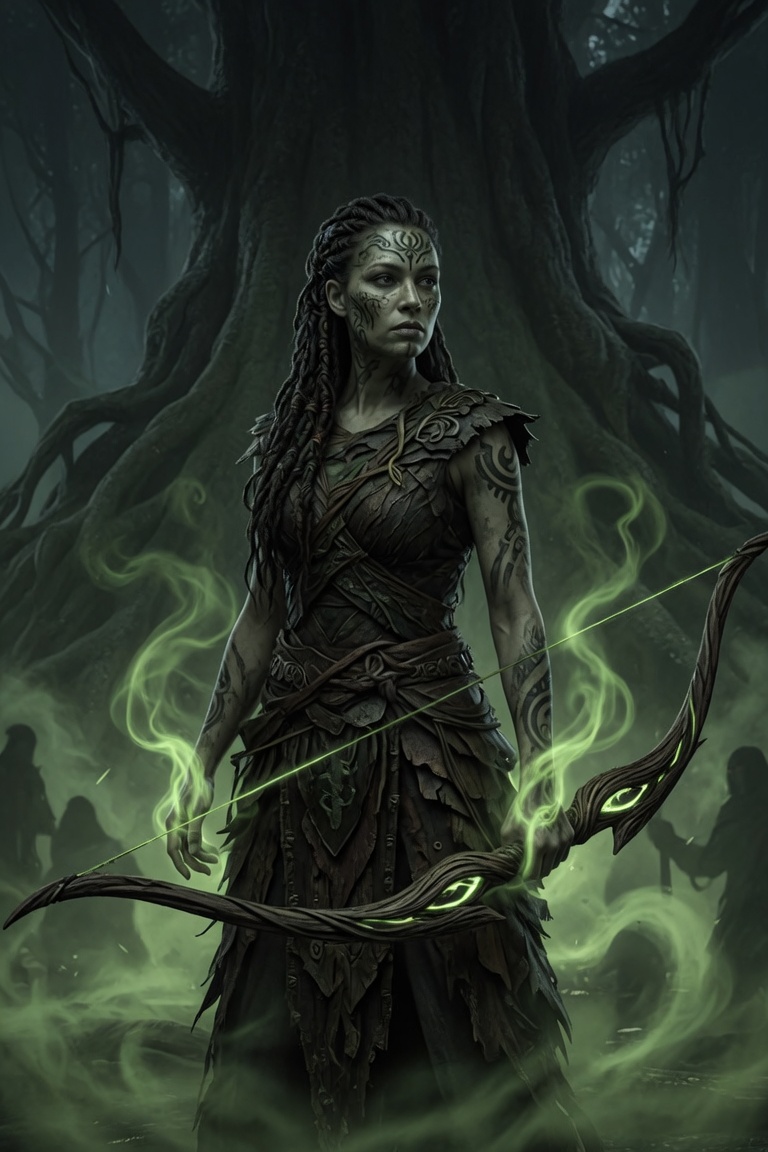
He was precise about it the way children are precise when they understand that the details matter — not embellishing, not retreating from the parts that frightened him, just laying it out in the sequence it had happened. The green light first, low to the ground, moving between the outer trunks with a patience he struggled to name and finally just called wrong because that was the truest word he had. Then her, stepping out of the trees the way something steps out when the dark doesn't frighten it — not carefully, not quickly, just fully, as though the tree line was a doorway and she had simply decided to use it.
He described her height. Her clothing, layered and dark, nothing made in any shop on any world he'd ever heard of. Her hair. The green light moving around her hands like something that was almost alive. The way she stood at the edge of the settlement and looked at it.
He got to that part and stopped for a moment.
"She wasn't looking for anything," he said. "That's what I keep thinking about. People look at things because they want something from them. She just — looked. Like she was deciding."
Homer was quiet for a moment. "Did she see you?"
Pell hesitated. "Her eyes went across where I was. She didn't stop. But I don't —" He paused. "I don't know if that means she didn't see me or if it means she saw me and it didn't matter."
Homer picked up his cup. Looked into it. Set it back down.
"You did right," he said. "Telling me."
In the morning Homer called everyone together.
Pell stood in the center of the room with twelve adults arranged around him and told it again, the same way he'd told Homer, leaving nothing out. The room listened with the particular quality of attention that descends when people are hearing something they were already half-prepared to hear — not surprise exactly, but the specific gravity of a suspicion becoming a fact.
When he finished nobody spoke for a moment.
Then Dasha said quietly, "That's what I saw. Before Alis. That's exactly what I saw."
The man who had been offering explanations at the first meeting — the one Edran had looked at — sat down in one of the chairs and put his hands on his knees and looked at the floor.
Edran was looking at the wall. His jaw was set in the particular way it had been set since the morning he'd stood in the doorway and looked at the tracks in the soft earth and understood what he was looking at. He had been patient since then in the way of a man whose patience is not peace but simply the discipline of waiting for the right moment. His head turned slowly toward Homer.
Homer didn't need to say anything. He could see it moving through the room without him — the shift that happens when people who have been waiting realize that waiting has already given its answer and the answer was a girl standing alone in the mist looking at their settlement with the patience of someone who has already decided it belongs to her.
The Republic had logged them in the appropriate records.
Whatever was at the tree line didn't need records.
"We go today," Homer said. Not a question. Not a rallying cry. Just the next true thing, stated plainly, the way he'd been stating true things in this room for thirty years. "We follow the tracks while they're still readable. We find out what we're dealing with. We come back and we make a plan based on what we actually know instead of what we're afraid of."
He looked around the room.
"Anyone who comes, comes. Anyone who stays, stays."
He picked up his pack from beside the hearth.
Edran stood up.
The two who had been ready since the first meeting were already moving.
Three others followed, one by one, in the quiet way of people making a decision they've already made and are only now admitting.
The man in the chair stayed where he was.
Pell looked at his mother.
His mother picked up her pack.
Pell followed her out into the morning, where the mist was doing its slow retreat from the settlement's edge and the tree line stood where it always stood, patient and dark and full of the tracks of people who had gone in and not come back.