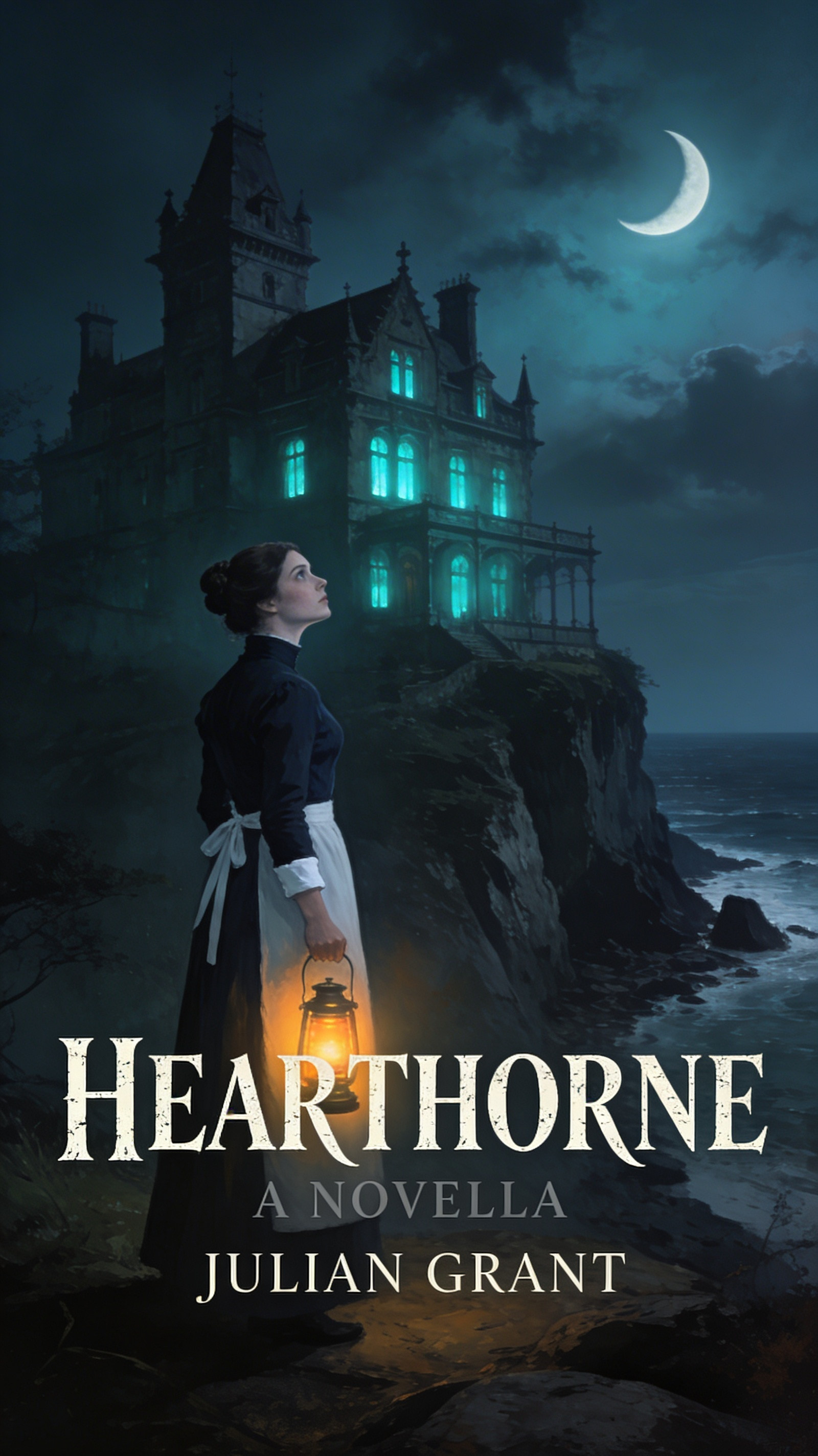

From the Private Journal of Beatrix Chalmers
Written in transit, October 14th, 1870
Morning - Liverpool Station
The journey from London was unremarkable save for the gradual transformation of landscape outside the carriage window. The pastoral scenes of the south gave way to the industrial grimness of Manchester, and then to something stranger still—a landscape that seemed to resist human habitation. The towns grew smaller and meaner, the vegetation more twisted and sparser, until at last we reached Liverpool where even the grandeur of the station could not quite dispel the sense of having traveled not merely north, but somehow backward in time.
I consulted Bradshaw's Guide over breakfast in the station tearoom. The entry for Hearthorne and its environs was notably brief:
"The coastal regions north of Liverpool offer magnificent views of the Irish Sea but limited modern conveniences. Transportation irregular. Travelers are advised to make firm arrangements in advance. The area is notable for its ancient monuments and persistent local legends. Sensitive travelers may prefer more conventional destinations."
Sensitive travelers. What an odd phrasing.
The proprietress of the tearoom, a ruddy-faced woman with capable hands, noticed my reading material. "You're going to Hearthorne, then?" Her tone suggested this was not a question so much as a statement of inevitable doom.
"I am. I've accepted a position there."
"Have you now." She poured my tea with the careful attention of one performing a ritual. "The Soames house. Well. You're the fourth this year, aren't you?"
"The fourth?"
"Nurse. They keep sending for nurses from London. Never keep them long, though." She leaned closer, her voice dropping to a whisper that nevertheless carried to every corner of the small establishment. "My sister's girl, she works in the village. Kettering, they call it, though it's barely that. She says there's things not right up at the manor. Says the lady of the house—" She paused, seeming to think better of her words. "Well. I'm sure it's all nonsense. Village folk and their superstitions."
"What does the lady of the house do?" I pressed, ignoring the flicker of unease in my chest.
The woman straightened, her professional demeanor reasserting itself. "Nothing that's my business to discuss with strangers, miss. You seem a sensible sort. I'm sure you'll form your own opinions."
She would say no more, though I saw her cross herself as I left to arrange my onward transportation.
Afternoon - The Hired Carriage
The two pounds Lady Soames provided for conveyance proved barely adequate. The driver who agreed to make the journey to Hearthorne demanded one pound fifteen, claiming the roads were treacherous and his horses would require extra feed and care after such an arduous trip.
I did not argue. I could not afford to.
He was a grim-faced man of perhaps fifty years, weather-beaten and taciturn. He loaded my single valise with an expression that suggested he was conveying a coffin rather than luggage.
"You're sure about this, miss?" He asked as I climbed into the carriage. "Hearthorne's a queer place. Not too late to change your mind."
"I am quite certain, thank you."
He grunted and climbed onto his perch. The horses, sensing perhaps the reluctance of their master, required considerable urging before they would proceed.
The journey was, as Bradshaw warned, less than pleasant.
We traveled north along the coast road, the Irish Sea appearing intermittently between stands of twisted vegetation. The trees here are peculiar, bent nearly horizontal by the constant wind, their branches reaching inland as though trying to escape the water. They remind me of skeletal hands clawing at the earth.
The Bradshaw Guide was correct about one thing: the views are indeed magnificent. And terrible. The sea is a gray-green mass that crashes against black rocks with a violence I find disturbing. There is nothing gentle in these waters, nothing of the pleasant seaside resorts I visited as a child with Mother and Father.
This sea wants to devour.
I cannot help but remember Brighton, though I try not to. I was seven years old, playing at the water's edge while Mother and Father watched from their beach chairs. The water seemed playful then, gentle waves that tickled my feet and made me laugh.
Until it wasn't gentle anymore.
I remember the sudden pull, the way the sand disappeared beneath my feet. I remember opening my mouth to scream and tasting salt, choking on it, my lungs burning. I remember tumbling in the green darkness, unable to tell which way was up.
And I remember something else. Something I have never told anyone.
There was something in the water with me. Not a fish or seal or any natural creature. Something that wrapped around my ankle with fingers that were not fingers. Something that pulled me deeper, deliberately, purposefully, as though it had been waiting for me.
I saw it. Just for a moment, Father's hands found me and dragged me back to shore. I saw its eyes, vertical pupils, like a cat's but wrong, all wrong. And I saw something that might have been a mouth, opening in what could have been a smile.
Father said I imagined it. That the lack of air had caused me to hallucinate. Mother said it was a nightmare brought on by trauma. I learned not to speak of it.
But I remember.
The driver's shout jolts me from my reverie. We have stopped. A massive raven sits in the middle of the road, refusing to move despite the horses' approach. It is an enormous specimen, easily two feet tall, its feathers so black they seem to absorb light.
It cocks its head and looks directly at me through the carriage window. For a moment, this is fancy—I could swear it knows me. Recognizes me.
Then it spreads its wings and launches itself into the air with a cry that sounds almost like laughter.
The driver crosses himself and urges the horses onward.
Late Afternoon - Approaching Hearthorne
The landscape grows increasingly desolate. We have left behind even the pretense of civilization. There are no farms here, no cottages, no signs of human habitation. Only the twisted trees, the wind-scoured rocks, and the endless gray sky.
Ravens follow us. Not just one now, but dozens. They perch in the trees and on the rocks, watching our progress with what I can only describe as interest. Their calls echo across the wasteland, a harsh chorus that sets my teeth on edge.
The driver notices my attention. "They say the ravens remember," he calls back to me. "That they're older than the stones themselves. That they've seen things no Christian should speak of."
"Surely they're simply carrion birds," I reply, trying to keep my voice steady.
"Aye. And maybe that's why they're following us, miss. Maybe they know something we don't."
I choose not to respond to this.
The sea is closer now. I can hear it even over the wind and the wheels and the horses' hooves—a constant booming that resonates in my chest. The driver said we would follow the coast road directly to Hearthorne, and indeed the water is never far from view.
I try not to look at it.
But my eyes are drawn regardless, and I see things that disturb me. The rocks along the shore are strangely shaped, worn smooth in patterns that seem almost deliberate. In some places they form circles, in others what might be crude altars or platforms. The retreating tide reveals things half-buried in the sandstones carved with symbols I do not recognize, fragments of what might be statuary though depicting figures that seem wrong somehow, their proportions subtly disturbing.
Are these ancient monuments? Celtic ruins perhaps? Or something older still?
I fish Bradshaw from my bag and re-read the entry. "Notable for its ancient monuments and persistent local legends."
What legends? The Guide does not elaborate.
My head has begun to ache. Perhaps it is merely the long journey, the lack of proper food, the constant motion of the carriage. Or perhaps it is something else. The air here feels thick, weighted, as though a storm approaches. Yet the sky, though gray, shows no sign of rain.
I touch my fingers to my temple and they come away wet. A nosebleed. How strange. I have not suffered from nosebleeds since childhood, since—
Since Brighton. Since the drowning.
I press my handkerchief to my nose and lean back against the carriage seat, closing my eyes. The rhythm of the wheels is hypnotic. I feel myself drifting, the boundaries between waking and sleeping becoming unclear.
I dream, though I am not fully asleep.
In the dream, I am underwater again. But this time I am not drowning. I am breathing, though my lungs feel different, as though they have changed their function. I look down at my body and see slits opening along my ribs—gills, fluttering in the water's current.
This should terrify me. Instead, I feel a strange sense of rightness, of coming home.
Something moves in the depths below. Something vast. I can feel it more than see it, a presence so immense that the water itself seems to bend around it. It is rising. Coming closer.
And I want it to reach me.
"Miss! Miss, we're here!"
The driver's shout pulls me back to consciousness. I sit up too quickly and the world spins. My handkerchief is soaked through with blood, and I can taste copper in my mouth.
"Are you alright, miss?"
"Yes, perfectly well. Simply a nosebleed. The dry air, I expect."
He gives me a look that suggests he does not believe this explanation but is too polite—or too disturbed—to press the matter.
I look out the window and see Hearthorne Manor for the first time.
Evening - Arrival
Oh.
Oh God.
It is magnificent and terrible, precisely as I somehow knew it would be.
The manor rises from the windswept cliffside like something that grew there rather than was built. The stone is dark gray, almost black in the fading light, and pitted by wind and salt spray. The architecture is Irish in design, Lady Soames mentioned this in her letter—the house was created stone by stone based on its original source across the channel.
But why? What madness drives someone to replicate an entire manor and rebuild it on this desolate coast?
The building seems larger from the outside than should be possible. It sprawls across the cliff top, its wings extending in directions that don't quite make sense. Windows reflect the dying light like dead eyes. The roof is sharp and peaked, decorated with finials that from a distance resemble grasping hands.
Surrounding the main house is a low wall of the same dark stone, and beyond that, nothing but the cliff's edge and the hungry sea below.
There is no garden, no lawn, no attempt at beautification. Hearthorne stands naked and defiant against the elements, as though daring the wind and water to tear it down.
The driver brings the carriage to a stop in the courtyard. No one emerges to greet us. The windows remain dark.
"Your luggage, miss."
He has already tossed my valise onto the wet cobblestones with rather less care than I would prefer. I hear something inside break—the perfume bottle, almost certainly. Mother's gift, shattered.
The symbolism is not lost on me.
I pay him the remainder of his fee, and he counts the coins with careful attention, as though expecting me to cheat him.
"You're certain you want to stay, miss? I could take you back to Liverpool. Same price again, but…”
"That will not be necessary."
He shrugs, pockets his payment, and climbs back onto his perch. "God keep you, then."
The carriage pulls away with unseemly haste, the horses apparently as eager to leave as their driver. I watch until they disappear around the bend in the road, and then I am alone.
The wind howls. The sea crashes against the rocks below. The ravens, which had been silent during our arrival, resume their calling—a raucous chorus that sounds almost like laughter.
I pick up my valise. The smell of elderberry perfume is overwhelming, sickly sweet in the salt air. Everything inside will be ruined, soaked through with the scent.
A fitting beginning to my service at Hearthorne.
I approach the massive oak door and raise my hand to knock. Before my knuckles can touch the wood, it swings inward, revealing darkness.
A voice emerges from that darkness, male and rough.
"You must be Miss Chalmers."
I can see only the vague outline of a man, backlit by a shuttered lantern that provides barely enough light to see by.
"Indeed I am. To whom do I have the pleasure of addressing?"
No response. He simply stands there, a shadow among shadows, watching me.
The wind gusts, catching my skirts and lifting them indecently. I scramble to push them down, my valise falling to the ground with a wet thud.
From the darkness, I hear it: laughter. Low and choking, utterly without humor.
He is laughing at my humiliation, at my struggle against the wind.
I feel my temper rise, that dangerous quality Father always warned me to control. I am cold, I am exhausted, I am bleeding from my nose and reeking of elderberry perfume, and this man—this servant—stands in the doorway laughing at me.
"Sir," I say, my voice is as sharp as broken glass. "I would very much appreciate some assistance. And an introduction. I have traveled a considerable distance at the invitation of Lady Soames, and I do not expect to be kept standing in the rain like a vagabond."
It isn't raining yet, but I can feel it coming.
The man steps forward into the half-light. He is tall and lean, perhaps forty years of age, with a face that might have been handsome if not for the cruelty in his eyes. His dark hair is swept back from a high forehead, and his mouth is too thin, pressed into a line that suggests permanent disapproval.
"I am Reginald Jarvis," he says. "House man. You will report to me regarding your day-to-day duties with the master and mistress."
Not "pleased to meet you." Not "welcome to Hearthorne." Simply a statement of his authority.
"Mr. Jarvis." I force myself to nod civilly. "Would you be so kind as to assist with my luggage?"
His eyes flick to the valise on the ground, then back to my face. "You seem a capable woman, Miss Chalmers. I'm sure you can manage."
And with that, he turns and walks into the darkness of the house, taking his feeble lantern with him.
I stand alone in the courtyard, the wind tearing at my clothes, the smell of my mother's perfume making my eyes water, and I think: What have I done?
But there is no going back now. The carriage is gone. Night is falling. The storm is coming.
I pick up my ruined valise and step through the door into Hearthorne Manor.
The door slams shut behind me with a sound like a coffin lid closing.
Welcome home, Beatrix.
Welcome home.