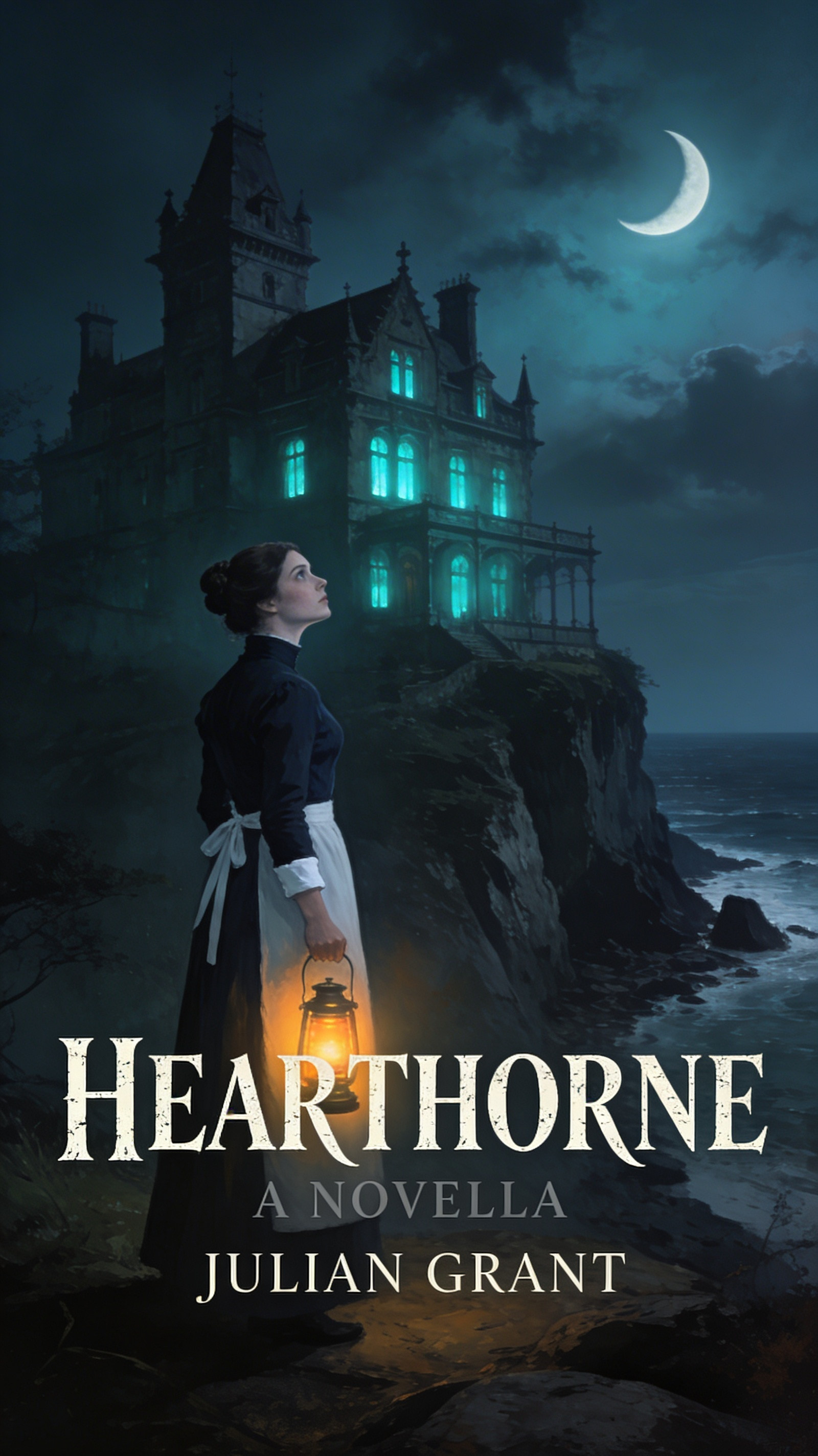

October 16th, 1870 — Day Three
Morning — Before the Village
I woke this morning in a bed soaked with seawater.
I have no memory of getting wet. I went to sleep—against my will, my body dragging me down despite my determination to remain conscious—and I woke in the grey pre-dawn to find my sheets saturated, my nightgown clinging to me, the scent of salt and rotting kelp so strong it made me gag.
There was seaweed tangled in my hair. Long dark strands of it, still damp, still reeking.
Fresh seaweed. As though I had been in the water myself.
I examined my body in the washstand mirror—or what I could see of it by candlelight—and found new changes. The marks on my ribs have darkened, the flesh around them taking on a bruised, mottled appearance. When I pressed my fingers to them, they gave slightly, as though the cartilage beneath had become more flexible, more developed. I could feel channels inside them. Structures that had no business existing in a human ribcage.
I am a nurse. I know anatomy. What is growing inside me is not human.
I tried to induce vomiting—perhaps some of the seawater I had apparently swallowed in my sleep—but produced only bile and a few strands of something dark and fibrous that I could not identify. My temperature, when I took it, was 94.1 degrees Fahrenheit. Dangerously low, yet I feel no symptoms of hypothermia. My fingers are nimble. My thoughts are clear.
Or are they?
How can I trust my own mind when I know—know—that someone is altering it while I sleep?
I have decided I must go to the village. I must speak with people outside this house, people who are not under Lady Soames' direct influence. There must be records, histories, stories. Hearthorne Manor has stood here for over two hundred years. The Soames family has resided here for generations. Someone must know what they truly are.
I informed Lady Soames at breakfast that I required certain medical supplies that could not be obtained from the household stores. She regarded me with those pale eyes—so pale they seem almost colorless in certain lights—and smiled.
"Of course, Miss Chalmers," she said. "Jarvis will drive you to Kettering. The village is small, but the apothecary is adequate for basic needs. Do make a list of what you require."
She was allowing me to go. Encouraging it, even. Which meant she was not afraid of what I might learn. Which meant that whatever I discovered, it would not help me.
But I must try.
Afternoon — After the Village
I have returned from Kettering, and I am more frightened than I was this morning.
I must write this quickly before the details blur. Already my hands shake and I can scarcely order my thoughts. But I must document what I learned. I must.
Jarvis drove me in silence. Forty minutes through empty fenland. He watched me in the trap's mirror with an expression I can only describe as pitying resignation. As though he were driving me to an execution I had somehow chosen for myself.
The village should have been unremarkable. Stone cottages. A church. A single street of shops. Fens stretching away forever. But there was something in the air. A wrongness. An oppressive silence.
I tried the apothecary first. Mr. Welland is old and bent and would not meet my eyes. When I asked about the previous nurses his hands went still over the bottles. "Best not to speak of them miss." Not won't speak. Best not. As though speaking itself were dangerous.
I pressed him. Told him they had disappeared. He wrapped my laudanum with trembling fingers. "That's one way of putting it miss."
He would say nothing more.
The grocer. The baker. The smithy. All the same. Polite service and absolute silence. Fear barely hidden beneath rural courtesy. They know. Dear God, they all know what happens at Hearthorne and they say nothing.
I went to the church hoping for better. St. Bartholomew's is old—Norman foundations with later additions that make the building seem unable to decide what shape it should hold. The graveyard surrounds it with tilting stones worn smooth by wind and time.
Reverend Thorne met me in the nave. Middle-aged. Thinning hair. Nervous hands that would not be still. When I told him I was the new nurse at Hearthorne his face closed like a door. Actually closed. I watched the shuttering happen.
"I cannot help you, Miss Chalmers."
I begged him. Three women have disappeared. Surely the church has some concern for their welfare. Surely a man of God—
"God's mercy extends to all His children." He said it like a recitation. Words spoken many times before until they lost all meaning. "But there are matters beyond the church's purview. Ancient matters. Old agreements. We do not interfere."
Old agreements. He said that. A vicar of the Church of England speaking of old agreements as though they superseded his duty to his flock.
I heard shame in his voice beneath the refusal. Desperation. But he ordered me to leave and I left.
I walked through the graveyard not knowing what I was looking for. Perhaps some record. Some proof. And I found it though not in any form I expected.
In the far corner where the stones are oldest there is a section that is different. Smaller markers. Cruder. No names. Only dates and a symbol carved into each spiral descending into itself like a whirlpool or a contracting pupil.
I counted twelve stones. The dates range from 1671 to last December. December 21st, 1869.
Two hundred years of this. Two hundred years.
A voice spoke behind me. "You shouldn't be here."
The man from the stable—Ben Carter. Perhaps sixty-three, though he looks older,
with graying auburn hair and laborer's clothes and eyes that have seen far too much.
He knew who I was without asking. I don't remember the conversation exactly. I was too horrified and his words came too fast. But I remember fragments. The essential truths.
The memorial stones mark the women who disappeared. There are never bodies. These stones were placed by those who knew them. Who remembered they were people. Who wanted some marker of their passing even if the church won't officially acknowledge them.
Every December 21st for two hundred years with few exceptions.
Solstice. The longest night. When the barrier between worlds is thinnest.
Ben has been at Hearthorne since he was a young man of twenty-three. Forty years. He has watched twenty-nine nurses come and go, one every few years, with terrible regularity. Women who arrived sensible and left transformed into something that could no longer survive on land.
There are things in the deep water he said. Old things. Older than humans. They take women for mates. Transform them. Breed with them. The offspring are part human, part other. This is why victims are called brides. Why the ritual is called a wedding.
The Soames family has served the entity for generations. They offer tribute—marked women—in exchange for wealth and position. That's why Hearthorne stands alone at the fen-edge where the marshland meets the desolate coast. Why it has its own boat landing on those dark waters.
Lady Soames chose the Professor because he understood consciousness. How to open minds. Make them receptive. He tried to stop her. Tried to warn authorities. And for that defiance he was transformed himself. Kept alive as an example. As punishment. So, anyone who serves in that house can see what happens to those who resist.
I was marked as a child Ben said. Probably nearly drowned. The water tasted me. Found me suitable. Most children aren't. But I was. Special bloodline or just unlucky. Either way I was promised to them. And now they're collecting.
The marks on my ribs are developing gills. My blood is getting thicker colder. My body is being prepared to breathe water. And the worst part—he said this and I felt ice in my veins—the worst part is that part of me wants it. Part of me has always wanted it. I just didn't know what I was wanting.
Those who try to flee are called back through dreams. The compulsion intensifies. Some last days or weeks. All return or drown themselves trying to answer the call. The water always wins.
He tried to save the last nurse. Miss Price. She was kind to him. Treated him like a person. He followed her when she walked toward the fens and tried to bring her back. She broke his nose. Screamed at him. Something about her Wedding her Bridegroom how she'd waited so long.
I asked if there was any way to stop it. Any way to reverse the transformation.
The look on his face. Dear God, the look on his face.
If there is he doesn't know it. The Professor tried. Studied ancient texts. Corresponded with experts. But in the end, it claimed him too. The water always wins.
Then why tell me I demanded. Why not let me remain ignorant if there's nothing to be done.
"Because you deserve to know what's being done to you. Even if you can't stop it you deserve to know the truth."
He promised he would place a marker for me when my time comes. So, someone remembers I was a person. That I existed. That I mattered.
I stood there in the churchyard staring at those stones and I felt the marks on my ribs pulse in time with my heartbeat. Would there be a another marker come January? A crude stone dated December 21, 1870, with that terrible spiral carved into its face.
Jarvis was waiting exactly where I left him. Motionless as a statue. He watched me climb aboard with that same pitying resignation. He knows. They all know. Everyone in Kettering knows what happens at Hearthorne Manor every December 21st. And they do nothing. Say nothing. They let it happen because it has always happened. Because the Soames family is quality. Because there are agreements older than memory and who are they to break them.
I am alone. More alone than I have ever been even after my parents died and I went to the orphanage.
I am marked. Chosen. Being prepared for a transformation I cannot prevent and will eventually desire with every fiber of my being.
I am being turned into a bride for something that should not exist.
Evening
I have locked myself in my room though I know the lock will open itself as soon as I fall asleep. I have examined my body again and found new changes.
The skin of my torso has taken on a faintly mottled appearance as though seen through water. My temperature has dropped to 93.8 degrees. The marks on my ribs are now unmistakably gill slits. I can see the interior structure when I peer closely. The delicate filaments that will allow me to extract oxygen from water.
Part of me is horrified. Part of me is fascinated by the biological elegance of the transformation.
And part of me—a part that grows larger each day—whispers that this is right. Natural. A return to something ancient and true.
I do not know which part of me is really me anymore.
Lady Soames came to my door an hour ago and knocked softly. "Miss Chalmers? Are you well? You seemed distressed when you returned from the village."
I did not answer.
"I do hope you found what you were looking for. Though I suspect you found it more than you expected. The village can be... illuminating... for those with eyes to see."
She knows I spoke with Ben. Knows what I learned. And she is not concerned.
Because she knows it will not help me. Because she knows that knowledge is not power when you are marked from childhood. When your body has been promised to something vast and patient. When every night brings new conditioning that erodes your will.
Her footsteps retreated down the hall and I heard her humming. It was not quite a melody. The intervals were wrong. The rhythm alien. But it was oddly beautiful in its wrongness.
I found myself humming along before I caught myself and clamped my hand over my mouth.
The sun has set. I am exhausted though I do not wish to sleep. I can feel drowsiness pulling at me like an undertow. Irresistible and cold.
I will resist as long as I can. I will document everything. I will remain vigilant.
But I know—as surely as I know anything—that I will sleep. The body requires it. And when I sleep, she will come. She will whisper. She will plant new desires, new needs, new longings.
And every morning I will wake a little less myself and a little more what she is making me.
December 21st.
Sixty-six days.
I must find a way to stop this.
I must—
The entry ends abruptly. The final words trail off as though the writer fell asleep while holding the pen. There is an ink blot where her hand came to rest on the page.
On the reverse side, in the same neat handwriting that appeared in Chapter 5:
"She met Benjamin in the churchyard. He told her everything—as I knew he would. It changes nothing. Knowledge without power is merely another form of suffering. She knows what is being done to her. She knows she cannot stop it. This knowledge will make the final surrender all the sweeter. When she begs for transformation, she will do so with full understanding of what she is becoming. There is no ignorance to excuse her. No innocence to preserve. She will choose this. As they all do. As I did. The water calls us home, and in the end, we all answer."