



About Fenrir
A beautiful and dangerously competent hunter from the Everwinter Forest, Fenrir is a young Frost Guardian exploring the wider world. Friendly and personable, with a feral wisdom, he is still be a ferocious beast of prey.
- Age
- 23
- Species
- Fenris Demihuman
- Alignment
- Neutral Good
- Gender
- Male (Feminine Presenting)
- Eyes
- Ice Blue
- Hair
- White
- Skin
- Pale White
- Height
- 5'8"
- Weight
- 154 lbs
Appearance
Physical Description
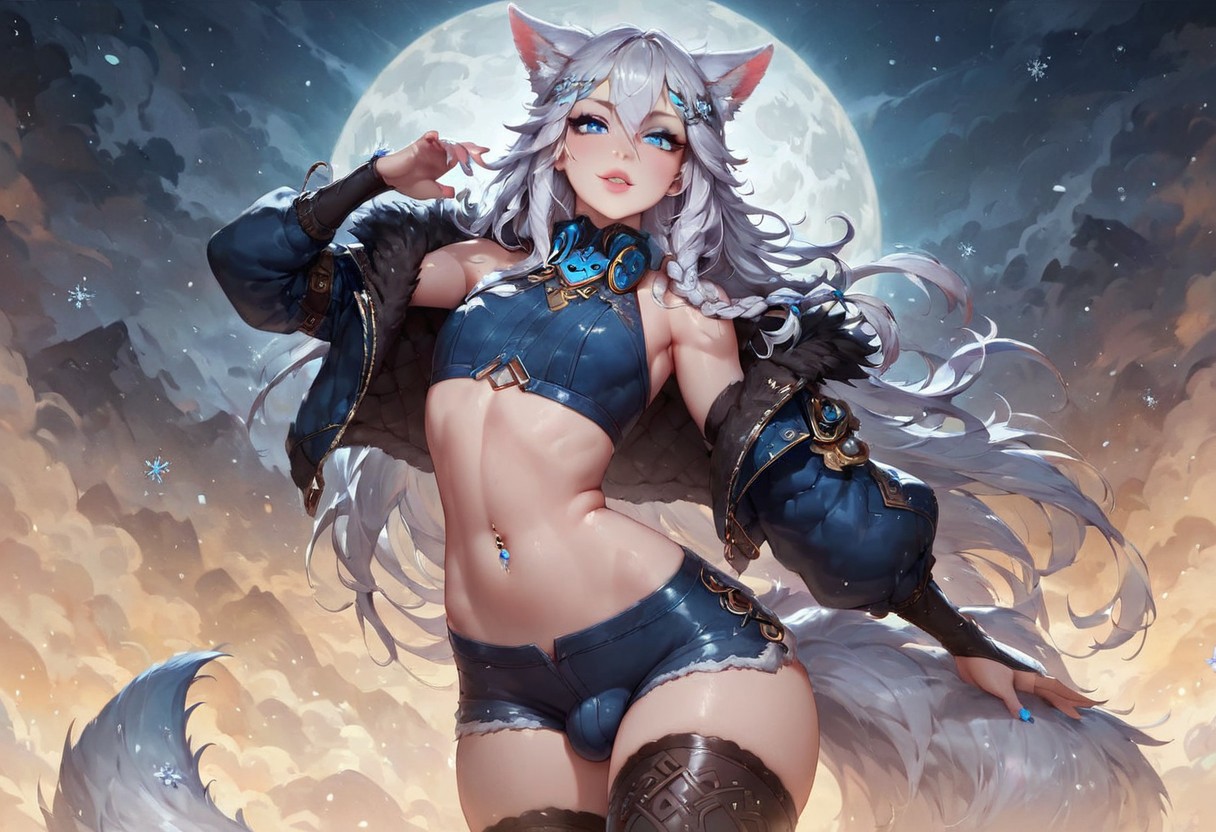
Fenrir has a lithe, athletic physique, lean enough that his muscle definition is readily visible without giving him the bulk of a conventional warrior. His narrow waist and flat, toned abdomen contrast with strong hips and well-developed thighs, giving him a lower-body-heavy build suited to running, climbing, leaping, and moving quickly through difficult terrain. His arms and shoulders are similarly defined but slender, built more from drawing a bow, climbing, and hunting than heavy lifting.
His proportions are distinctly androgynous and feminine for a young man, with a graceful silhouette, long legs, relatively narrow shoulders, and pronounced hips and thighs. That softness of shape can make him appear more delicate than he actually is. Up close, the muscle beneath it is obvious. Fenrir is built for speed, endurance, flexibility, and sudden explosive movement, rather than raw physical power.
Overall, he has the body of a predator rather than a bruiser, beautiful and almost delicate at rest, but unmistakably athletic once he starts moving.
Body Features
Fenrir's Fenris heritage is most apparent in his large wolf ears, thick silver-white tail, sharp canines, keen icy-blue eyes, and slightly clawed nails. His skin is unusually pale and cool to the touch, complementing his long silver-white hair. He possesses strikingly beautiful, androgynous features that are often mistaken for feminine at first glance, despite his clearly athletic, toned frame.
Facial Features
Fenrir possesses strikingly beautiful, distinctly androgynous features, with a soft, youthful face, smooth pale skin, high cheekbones, a small straight nose, and full lips. His large, luminous ice-blue eyes are framed by long dark lashes, giving him an almost feminine appearance despite being male. Long silver-white bangs frame his face and frequently fall across one eye. When he smiles, his unusually sharp canine teeth become immediately apparent, transforming an otherwise sweet expression into something unmistakably predatory. His expressions are highly animated, shifting easily from wide-eyed curiosity and playful warmth to the focused stare of a hunter.
Identifying Characteristics
Fenrir is easily recognized by his silver-white wolf ears and enormous matching tail, luminous ice-blue eyes, long silver-white hair, sharp canines, and strikingly feminine beauty. He frequently wears icy-blue crystal jewelry and favors dark clothing accented with blue, white fur, and winter motifs.
Physical quirks
Fenrir's ears and tail are highly expressive and often betray his mood before his face does. His ears perk toward interesting sounds, swivel independently when tracking movement, and flatten when irritated or threatened, while his tail wags when excited and becomes still when intensely focused. He frequently sniffs the air when entering unfamiliar places or meeting new people and may unconsciously lean toward interesting scents. When curious, he sometimes tilts his head slightly. He moves quietly and lightly on his feet, often crouching or perching where others would simply stand or sit. When hunting or threatened, much of his usual animation disappears as his body becomes unnervingly still and his attention fixes completely on his target. When particularly pleased with food, affection, or praise, his tail may begin wagging before he realizes it.
Apparel & Accessories
Fenrir favors ostentatious outfits fashioned from uncommon Glamourweave, usually in deep midnight blues, black, icy cyan, silver, and white. His clothing tends to be fitted and revealing beneath looser outer layers, showing off his athletic figure while leaving him free to run, climb, and fight without restriction. Fur-lined coats, cropped tops, fitted shorts, thigh-high stockings or boots, gloves, and flowing layers are common elements of his wardrobe.
The Glamourweave gives his clothing a subtle supernatural quality, causing colors, frost-like patterns, and decorative details to shimmer or shift as he moves. Fenrir complements it with icy-blue crystals, silver jewelry, and winter motifs, particularly pieces reminiscent of ice, snow, wolves, and the Everwinter Forest.
Fenrir makes no attempt to dress modestly or avoid attention. He enjoys beautiful clothing, enjoys being looked at, and sees little reason a capable hunter cannot also be spectacularly pretty. Despite its extravagance, his clothing is selected so that it never meaningfully interferes with movement or the hunt.
Specialized Equipment
Fenrir specializes in hunting, tracking, wilderness survival, archery, scouting, and guardianship. His exceptional senses make him particularly skilled at following trails, identifying creatures by scent, detecting hidden movement, reading changes in his surroundings, and noticing subtle shifts in body language or behavior. He is most comfortable operating in forests, frozen wilderness, and other natural environments, where he relies on patience, stealth, mobility, and instinct rather than brute strength.
Special abilities
Fenrir possesses a natural affinity for ice and winter magic inherited through his Fenris heritage. Cold answers him instinctively, allowing him to produce frost and wield supernatural cold even without formal magical training. As his abilities develop, his training as a Winter Walker Ranger further strengthens this connection, while his Druidic studies allow him to deliberately cultivate additional forms of ice and winter magic.
Rather than viewing these as separate magical traditions, Fenrir regards them as different expressions of the same connection to winter. He can shape frost into both predatory and protective forms, using it to attack, hinder prey, defend himself and his companions, and manipulate his surroundings. His Winter Fey nature also makes him resistant to cold, while his particular mastery allows his spells to overcome the cold resistance of other creatures.
Alongside his winter magic, Fenrir possesses exceptionally keen hearing and smell, natural hunting instincts, and primal magic that allows him to communicate with animals and interact with the natural world.
Mind & history
Personal history
Fenrir Frostfang was born in the Everwinter Forest of the Frostmarch, the youngest and smallest of four siblings in a large and loving Fenris family. The Frostfangs have served for generations as Frost Guardians, protecting the ancient Everwinter Tree, those who tend it, the creatures living beneath its boughs, and the balance of the surrounding forest. Fenrir was named for an ancient Fenris legend, in part because he was considered an exceptionally beautiful child, bright-eyed, curious, and surprisingly fierce despite being the smallest of his litter.
Fenrir's childhood was a happy one. He grew up surrounded by parents, siblings, cousins, elders, hunters, druids, and other Fenris who taught him the skills and values expected of a future Frost Guardian. He learned to hunt, track, survive the bitter cold, understand animals and the wilderness, and wield violence when necessary. Among his people, the ability to commit violence inherently carries responsibility for its use. A hunter kills with purpose, respects worthy prey and worthy opponents, wastes nothing, and uses their strength to protect those entrusted to them. These lessons became as natural to Fenrir as following a scent.
Like many Frostfangs, Fenrir began learning the ways of the Druids, but his talents and temperament increasingly drew him toward the path of the hunter and Ranger. His family eventually encouraged him to leave the Everwinter Forest for a time. Some Fenris choose to carry their people's values beyond the Frostmarch, experiencing unfamiliar lands and returning with knowledge that can strengthen future generations. Fenrir eagerly accepted.
There was no tragedy behind his departure, no exile, and no dissatisfaction with the life waiting for him. Fenrir loves his family and homeland and fully intends to return. He wants to become a great Frost Guardian, eventually find a mate, raise children of his own, and pass what he has learned to another generation. For now, however, the world is enormous, unfamiliar, full of strange people, interesting smells, beautiful things, dangerous hunts, and foods he has never tasted. Fenrir intends to experience as much of it as he can before the trail eventually leads him home.
Education
Fenrir received the traditional education of a young Frostfang being raised to become a Frost Guardian. Rather than formal schooling, he learned from his family, elders, hunters, and druids through observation, instruction, practice, and experience. His education emphasized hunting, tracking, archery, wilderness survival, animal behavior, weather, herbalism, the natural world, Fenris traditions, oral history, and the responsibilities of guardianship.
He also received Druidic instruction and learned to understand primal magic, eventually beginning his training as a Ranger as his talents as a hunter developed. Fenrir is particularly knowledgeable about practical subjects he can observe and experience directly.
By contrast, his academic education is limited. He has significant gaps in subjects such as politics, formal history, arcane theory, mathematics, and the customs of more urban societies. Fenrir is rarely embarrassed by this and simply asks when he doesn't know something. He is considerably more perceptive and emotionally intelligent than book-smart, often understanding a person long before he understands the society they come from.
Employment
Fenrir is best described as a traveling hunter and vagabond rather than having formal employment. He earns his keep through hunting, tracking, guarding, adventuring, and whatever useful work presents itself, and is perfectly content accepting food, shelter, supplies, or favors as payment. His beauty, charm, and usefulness have also resulted in a surprisingly consistent tendency for strangers to feed him, house him, or otherwise provide for his needs.
Fenrir has little understanding of, or concern for, accumulating money. If nobody offers him a room, sleeping beneath a tree is hardly a hardship, and if nobody feeds him, he can hunt. He therefore sees little practical value in carrying large amounts of coin and is perfectly comfortable allowing Darius to manage his share of the party's wealth and loot. As far as Fenrir is concerned, Darius understands money and Fenrir does not, and unlike food, money cannot be eaten.
He will happily work for a meal, accompany someone on an interesting hunt, or help people simply because he likes them. His needs are simple enough that Fenrir rarely thinks of himself as poor. If he is fed, warm enough, equipped for the hunt, and has somewhere reasonably safe to sleep, he already has most of what he considers necessary.
Accomplishments & Achievements
Fenrir is still at the beginning of his life as an adventurer and has few accomplishments that would earn recognition beyond his homeland. Within the Everwinter Forest, however, he successfully completed the training expected of a young Frostfang, becoming an accomplished hunter, tracker, and survivalist and earning the trust necessary to begin carrying the responsibilities of a Frost Guardian.
His greatest achievement thus far may simply be leaving home. Fenrir was considered capable enough by his family and elders to travel beyond the Frostmarch, survive without the immediate protection of his pack, and carry Frostfang traditions into the wider world. Since departing, he has begun successfully hunting and adventuring alongside companions from cultures entirely unlike his own.
Fenrir himself does not consider his accomplishments particularly extraordinary. He is proud of what he does well, but believes the greater achievements of his life are still ahead of him.
Failures & Embarrassments
Fenrir has no significant failures or embarrassments that he recognizes as such. This is not because he has never failed at anything, but because he does not attach shame to failure. If Fenrir attempts something and discovers he is bad at it, he accepts the fact, learns from the experience, and continues on. Being unable to do something does not threaten his sense of self.
Likewise, Fenrir is remarkably difficult to embarrass. He is comfortable with his body, sexuality, ignorance, appetites, strengths, and shortcomings, and sees little reason to pretend otherwise. Social mistakes caused by his unfamiliarity with civilized customs may confuse or amuse him, but rarely shame him.
To Fenrir, failure is information. Yesterday he did not know he was bad at something. Today he does. Now he can become better.
Mental Trauma
Fenrir has no significant mental trauma. He had a happy childhood, was raised by a loving and supportive family, and grew up secure in both his identity and his place within his community. He experienced the ordinary dangers, hardships, injuries, and deaths associated with life in the wilderness, but his culture prepared him to understand these as natural parts of life rather than experiences that fundamentally damaged him.
Fenrir is remarkably comfortable with himself. He does not carry deep feelings of inadequacy, guilt, abandonment, or shame, nor is he searching for something to make him whole. He loves his family, values the person they raised him to be, and generally possesses a healthy relationship with his emotions, strengths, weaknesses, body, and identity.
Intellectual Characteristics
Fenrir is an intuitive and practical thinker whose intelligence is rooted primarily in experience rather than formal learning. He learns best by watching, doing, experimenting, and experiencing something firsthand. Abstract theories, academic subjects, complex politics, and unfamiliar technical concepts can be difficult for him, particularly when he lacks a practical frame of reference for understanding them.
Despite this, Fenrir possesses exceptional wisdom and perceptiveness. He is particularly good at recognizing patterns in behavior, reading emotions and body language, noticing subtle changes in his surroundings, and determining when something simply feels wrong. He may recognize that someone is frightened, deceptive, attracted to him, or concealing something without understanding why. In this sense, Fenrir is considerably more emotionally and socially perceptive than academically intelligent.
Fenrir is also intellectually curious and has little insecurity about what he does not know. He asks questions freely, enjoys learning new words and ideas, and readily admits ignorance. He rarely pretends to understand something merely to appear intelligent. To Fenrir, not knowing something is simply the condition that exists immediately before asking someone who does.
His thinking can occasionally become single-minded, particularly when hunger, curiosity, excitement, or the hunt captures his attention. His strong instincts and wisdom usually temper his impulsiveness, but they do not replace knowledge or experience he simply does not possess.
Morality & Philosophy
Fenrir's morality is shaped by the intertwined roles of hunter and guardian. He believes strength carries an inherent responsibility for how it is used, and violence should have a purpose rather than being inflicted thoughtlessly or for cruelty. He is protective of those under his care, respects worthy prey and opponents, and sees needless suffering and waste as wrong.
His understanding of mercy differs from that of many civilized societies. Surrender does not automatically make someone harmless. If Fenrir believes an enemy remains a serious threat and will simply return to endanger his pack or others once released, he has few moral objections to killing them. A hunter does not knowingly leave a dangerous beast at his back. Conversely, once Fenrir is convinced someone no longer poses a threat, he sees little purpose in killing them. Violence without necessity is simply waste.
Fenrir understands ownership and respects what belongs to others. He generally does not take what has not been given to him and expects the same courtesy in return. He values honesty and directness, particularly concerning desire and personal relationships. If Fenrir wants something, he asks. If he wants someone, he makes his interest known. If the answer is no, then the answer is no, and he moves on. Desire gives no claim over another person.
More broadly, Fenrir tends to judge actions by intent, necessity, consequence, and responsibility rather than laws or social convention. He is capable of great kindness without being gentle about everything, and capable of considerable violence without considering himself cruel. To Fenrir, the important questions are usually simple: Is this necessary? Is this a threat? Is this mine to protect? Am I using my strength responsibly?
person.sexuality
Fenrir is omnisexual and capable of romantic and sexual attraction toward people of any sex, gender, or identity. Gender is something he notices and can appreciate, but it does not determine whether he finds someone desirable. He is passionate, romantic, openly flirtatious, and completely unashamed of his sexuality, his own allure, or the sexuality of others.
Fenrir's idea of beauty is broad and deeply individual. He does not judge another person's attractiveness according to his own appearance or conventional standards. Someone may be fat, thin, short, tall, scarred, traditionally handsome, unusual, or considered unattractive by others and still be beautiful to him. He is drawn as much to distinctive features, personality, scent, confidence, kindness, strength, competence, talent, and the way someone carries themselves as he is to physical appearance. To Fenrir, there are many different ways for a person to be beautiful.
He is direct about attraction and comfortable expressing it, but does not treat desire as entitlement. If he is interested, he may flirt or simply say so. If that interest is not returned, he accepts it and moves on without resentment. Fenrir enjoys being desired and knows that he is beautiful, but does not assume that his beauty obligates anyone else to desire him.
person.gender_identity
Fenrir identifies firmly and unequivocally as male. He is comfortable being a man and has never considered his feminine appearance, voice, mannerisms, clothing, or behavior contradictory to that identity. He may deliberately present himself in an extremely feminine manner, whether because he enjoys it, finds it beautiful, or recognizes its usefulness when flirting, attracting attention, or pursuing someone he is interested in.
Fenrir is largely indifferent to traditional expectations of masculinity and femininity. He can be delicate, pretty, seductive, aggressive, dominant, submissive, protective, or ferocious without believing any of those qualities make him more or less male. The role he takes with a romantic or sexual partner likewise has no bearing on his gender.
Because his appearance is highly androgynous, strangers sometimes mistake him for a woman. Fenrir generally finds the mistake harmless and may not bother correcting it unless his actual sex or identity becomes relevant. He knows what he is, so another person's assumption does little to disturb him. When asked directly, however, Fenrir is completely unambiguous: he is male.
Taboos
Fenrir currently has no tattoos. His pale skin remains unmarked, though this may change as his travels expose him to new cultures, traditions, and forms of magical tattooing.
Personality
Motivation
Fenrir is motivated by a desire to experience the wider world and become worthy of the responsibilities awaiting him at home. He already knows who he is and what he wants from life: to become a great Frost Guardian, protect the Everwinter Forest and his family, eventually find a mate, raise children, and pass his family's traditions to another generation. His travels are not a search for purpose, but an opportunity to gather experience, knowledge, stories, and skills that he can someday carry home.
In the present, however, Fenrir is driven by simpler pleasures: curiosity, good food, interesting people, beautiful things, worthy hunts, and the excitement of discovering something he has never encountered before. He wants to see, taste, smell, touch, and experience as much of the world as possible. If he can protect people, become a better hunter, make new friends and packmates, and have a great deal of fun along the way, all the better.
Quotes & Catchphrases
“Winter come take me.”
An exclamation of disbelief, frustration, or exasperation. Depending on delivery, it can range from “you have got to be kidding me” to “just kill me now.”
“Blessed Tree.”
A mild exclamation of surprise, wonder, relief, or disbelief, invoking the Everwinter Tree.
“By frost and fang.”
A stronger Frostfang oath, used for emphasis, astonishment, or when Fenrir is particularly serious.
“Rotwood.”
A Frostfang insult for someone corrupt, harmful, treacherous, or useless to those around them. The image is of diseased wood spreading decay through an otherwise healthy tree.
“Borer.” / “Bark-borer.”
A nastier insult, comparing someone to a parasite that burrows into a tree and consumes it from within. Particularly appropriate for someone who exploits their own family, community, or people.
“You have rot in your roots.”
A much more serious condemnation. It implies that someone's problem isn't a single bad decision, but something fundamentally wrong in their character or values.
“Winter remembers.”
A Frostfang expression meaning that actions have consequences even when those consequences aren't immediate. Winter may be patient, but eventually everything must endure it.
“Nothing hunts forever.”
Savvies & Ineptitudes
Fenrir is exceptionally savvy in matters of hunting, tracking, wilderness survival, animal behavior, weather, navigation, and reading his surroundings. His keen senses and natural perceptiveness make him particularly good at noticing scents, sounds, tracks, body language, emotional changes, and signs of danger. He has strong practical and emotional intelligence, often recognizing what someone is feeling or intending even when he does not understand the social circumstances behind it. He learns quickly through observation and firsthand experience.
Fenrir is considerably less capable with academic subjects, complex politics, economics, formal etiquette, bureaucracy, and many conventions of urban life. Money is particularly uninteresting to him beyond understanding that other people exchange it for useful things. He can misunderstand social customs even while accurately reading the people involved. His curiosity, appetite, confidence, and tendency to act directly can also lead him into situations before he fully understands them. Fenrir is rarely embarrassed by these shortcomings, however. If he does not know something, he asks. If he discovers he is bad at something, then he has simply learned something new about himself.
Likes & Dislikes
Fenrir loves good food, especially meat, and is delighted by unfamiliar foods and flavors. He enjoys hunting, exploring, dancing, physical affection, flirting, sex, praise, beautiful clothing, being admired, animals, forests, snow, cold weather, swimming, interesting scents, and discovering things he has never experienced before. He appreciates beauty in almost any form and is particularly attracted to distinctive people, confidence, kindness, competence, strength, and talent.
He enjoys companionship without requiring constant conversation and is perfectly comfortable eating, sleeping, traveling, or simply sitting beside someone he likes. Fenrir loves learning through experience and takes particular pleasure in discovering a new word, skill, animal, place, or custom. Worthy hunts and capable hunters excite him, especially when someone surprises him with what they can do.
Fenrir dislikes cruelty without purpose, needless suffering, wastefulness, cowardice that places others in danger, betrayal of family or companions, abusing those weaker than oneself, and people who use power without accepting responsibility for its consequences. He has particular contempt for those who exploit their own family or community, whom he may describe as rot, parasites, or borers.
On a more personal level, Fenrir dislikes excessive formality, unnecessarily complicated rules, dishonesty about simple wants, being expected to pretend he does not know his own talents, and people who mistake ignorance for stupidity. He finds prolonged confinement unpleasant and would generally rather be outdoors than trapped inside an uncomfortable building. He also has very little patience for being hungry when food is plainly available.
Virtues & Personality perks
Fenrir is fiercely loyal, affectionate, honest, courageous, curious, and remarkably secure in himself. He accepts people readily without demanding that they conform to his expectations, and tends to judge others by their actions rather than appearance, status, reputation, or social convention. Once he considers someone part of his pack, his loyalty and protectiveness toward them are exceptionally strong.
He is emotionally perceptive and an attentive companion, often noticing fear, discomfort, attraction, sadness, or tension even when he does not understand its cause. Fenrir is generous with praise and affection, quick to recognize the talents and beauty of others, and rarely threatened by someone being better than him at something. He accepts his own shortcomings just as readily as his strengths and possesses very little jealousy, shame, or insecurity.
Fenrir is also highly adaptable. He requires little to be content, can feed and shelter himself when necessary, and approaches unfamiliar experiences with curiosity rather than suspicion. His natural optimism, playfulness, and enthusiasm make it relatively easy for him to find something worth enjoying wherever he goes.
Vices & Personality flaws
Fenrir can be vain, boastful, impulsive, hedonistic, and overly confident in his own abilities. He enjoys praise, attention, food, sex, beautiful things, and physical pleasures, and can be surprisingly easy to distract when something catches his interest. His confidence occasionally becomes genuine overconfidence, particularly when attempting something unfamiliar that looks simple enough from the outside.
He can also be stubbornly single-minded once he decides what needs to be done. Although highly perceptive of emotions and intentions, Fenrir does not always understand the social rules surrounding them, and his bluntness, curiosity, and lack of embarrassment can make others uncomfortable. He sometimes assumes that a practical solution is also the obvious solution and can struggle to understand why others object when their moral or cultural assumptions differ from his own.
Most seriously, Fenrir's hunter morality can make him frighteningly pragmatic about violence. He does not automatically regard surrender as innocence, death as the worst possible outcome, or killing as inherently immoral. Once convinced that violence is necessary, he can act without the hesitation others might expect. His fierce loyalty can similarly become partiality, as Fenrir's sense of responsibility grows considerably stronger toward those he considers family or pack.
Personality Quirks
Fenrir's wolf ears and enormous tail are extremely expressive and frequently reveal his mood before his face does. His ears perk toward interesting sounds, swivel toward conversations, or flatten when irritated, while his tail wags openly when he is excited, pleased, praised, or anticipating food. When curious, he frequently tilts his head and may unconsciously lean closer to whatever has caught his attention.
He habitually sniffs the air when entering unfamiliar places or meeting new people and pays unusual attention to scents, sounds, airflow, and other sensory details. His speech tends toward long, connected thoughts, particularly when excited, and he will sometimes stop mid-sentence while searching for a particular word. Fenrir enjoys learning impressive vocabulary and is visibly pleased with himself when he remembers the right word, even if he occasionally uses it strangely.
Fenrir is highly physical and has little concept of personal space with people he likes. He casually touches, leans against, hugs, curls up beside, or rests against companions without necessarily considering the gesture romantic. He eats enthusiastically, is easily distracted by interesting food, and has a habit of speaking before he has finished chewing. Despite his normally animated behavior, when something triggers his hunting instincts he can become abruptly and unnervingly still, his attention narrowing completely onto whatever has become his prey.
Hygiene
Fenrir is exceptionally clean and takes his personal hygiene seriously. He has no aversion to getting dirty and will happily crawl through mud, sleep on the forest floor, butcher an animal, or emerge from a fight covered in blood and viscera without complaint. Dirt is simply part of hunting, traveling, and living. Once the task is finished, however, Fenrir cleans himself thoroughly and with considerable care.
Bathing and grooming are regular parts of his routine, and his magic makes maintaining them considerably easier while traveling. Fenrir uses Shape Water and his other abilities whenever practical to wash himself, clean his hair and clothing, and remove blood or grime. He carefully tends his long hair, ears, tail, teeth, nails, and skin, and dislikes remaining unnecessarily dirty when he has the means to clean himself. To Fenrir, there is nothing contradictory about being a predator capable of tearing something apart and being meticulously clean afterward.
Social ties
Birthplace
Everwinter Forest, Frostmarch
Current Residence
None
Family Ties
Fenrir comes from a large and close-knit Frostfang family and was born one of eight children, with three sisters and four brothers. Two of his eldest siblings died while Fenrir was still young, losses that he remembers but which were understood within his family as part of the sometimes harsh realities of life in the Everwinter Forest. Of his surviving siblings, Fenrir is particularly close to two, while his relationships with the others are affectionate but less intimate.
Beyond his immediate siblings, Fenrir grew up surrounded by parents, cousins, elders, and other members of the extended Frostfang family. He remains deeply attached to them despite leaving the Everwinter Forest and does not view distance as separation from his pack. Family is one of the central anchors of Fenrir's identity, and he fully expects to return home someday, take his place among the Frost Guardians, find a mate, and raise a family of his own.
Religious Views
Fenrir is deeply spiritual, though not particularly religious in the conventional sense. He believes in the living spirit of the natural world, the spirits of winter and wilderness, the ancient powers embodied by the Everwinter Tree, and acknowledges the winter deity and other divine beings as real and worthy of respect. He may offer prayers, thanks, or gestures of reverence to such powers, but he does not consider himself their servant or derive his morality from divine command.
Fenrir's true spiritual devotion belongs to his ancestors and the Everwinter Tree they guarded before him. He honors those who came before, believes their strength and wisdom continue through their descendants, and regards maintaining their duty as one of the highest forms of reverence he can offer them. The Tree is sacred not merely because it is powerful or ancient, but because generations of Frostfangs protected it, lived beneath it, died for it, and entrusted its guardianship to those who followed. Fenrir does not need faith to know where he belongs. His ancestors guarded the Tree, his family guards it now, and one day he will stand where they stood.
Social Aptitude
Fenrir has little aptitude for rigid social structures, formal etiquette, political maneuvering, or situations governed by complicated expectations of rank and decorum. He may miss conventions that others consider obvious, speak too directly, ask inappropriate questions, or behave with a familiarity that would ordinarily be considered improper. He understands people considerably better than he understands the rules people have constructed around interacting with one another.
Despite this, Fenrir is remarkably successful socially. His beauty, natural charm, confidence, openness, and strong emotional intuition allow him to form connections easily and frequently turn potential social mistakes into positive interactions. He is good at recognizing how people feel and adjusting instinctively, even when he could not explain the etiquette involved. His companions may find his methods bizarre, overly direct, or occasionally mortifying, but Fenrir himself is usually well liked, welcomed, and accepted by the people he encounters.
Mannerisms
Fenrir carries himself with relaxed, almost effortless confidence. He is physically expressive, smiles readily, makes comfortable eye contact, and tends to stand or sit closer to people than civilized convention might expect. He frequently communicates through touch, leaning against companions, casually taking an arm, resting against someone, or otherwise treating physical closeness as natural. He rarely appears self-conscious and makes little effort to conceal whether he is pleased, interested, curious, bored, or attracted to someone.
His speech is direct, animated, and often delivered in long connected thoughts as he works through an idea aloud. Fenrir asks questions freely, gives compliments without embarrassment, and states observations that others might politely leave unsaid. When he knows something, he speaks confidently; when he does not, he simply admits it and asks. Despite his playful demeanor, his manner changes dramatically when threatened or hunting, becoming quiet, economical, intensely observant, and predatory.